

Myopia Control in Amarillo, TX
Helping Your Eyes Stay in Focus
Myopia, or nearsightedness, is a refractive error of the eye that leads to distant objects appearing blurry while nearby objects remain clear. It occurs when the cornea’s curvature is too steep, or the eye’s length is too long. Essentially, if you have myopia, it means the light entering your eye focuses in front of the retina instead of on it.

Symptoms of Myopia
Myopia commonly develops in school-aged children. Watch for signs of myopia in your child, because they may not be aware they are having trouble seeing:
- Unaware of or unable to see distant objects
- Squinting or rubbing their eyes
- Sitting too close to the TV or needing to sit close to the board at school
- Excessive blinking
- Headaches or fatigue
Diagnosis of Myopia
Myopia is diagnosed during a comprehensive eye exam. Children should have their eyes examined every year once they enter school, not only monitor their vision for changes but also to assess their ocular health.
Management Options
Most often, myopia is managed with prescription eyeglasses or contact lenses. These prescription lenses correct the refraction of light as it enters the eye, focusing the light directly on the retina. For some, glasses may only need to be worn for certain activities, such as driving or watching TV. Others may require them more often, depending on the severity of their myopia.
Corrective eye surgery is another option for correcting myopia. Laser eye surgery reshapes the cornea to reduce the patient’s prescription, while implantable lenses replace the natural lens with an artificial lens.
Myopia Control for Children
There are many ways myopia progression can be slowed or delayed in children. The most effective method for your child depends on their ocular health and development. The best place to start is to bring your child in for a comprehensive eye exam. Some myopia control options include:
- Corneal refractive therapy (CRT) reshapes the cornea with the aid of orthokeratology (Ortho-K) contact lenses. These lenses, which are worn while sleeping, are designed to flatten the curve of the cornea, reducing the need to wear glasses during the day.
- Multifocal soft contact lenses slow the progression of myopia in children by slowing the elongation of the eye. Multifocal soft contact lenses are shown to be more effective at slowing myopia progression than bifocal lenses.
- Atropine drops are shown to slow the progression of early childhood myopia. Although they don’t completely remove the need for eyeglasses, a low dose of atropine drops prevent myopia from worsening.
- Multifocal or bifocal eyeglasses are the least invasive method of myopia control. They are shown to slow the progression of myopia in children by reducing accommodative effort when switching between distant and close-up objects.
If your child has been diagnosed with myopia, please book an appointment for your child to discuss different methods of myopia control.
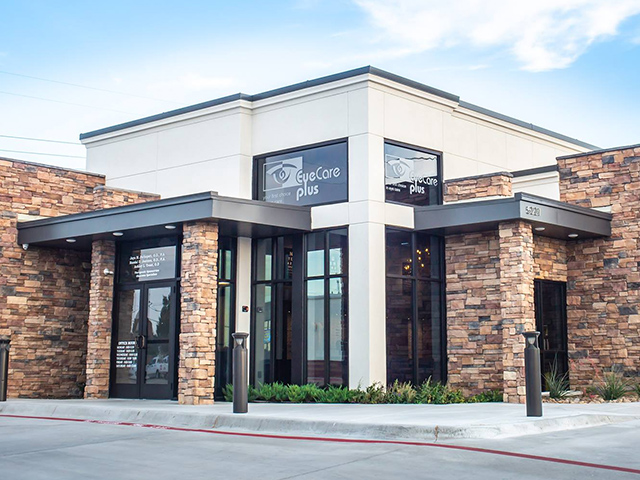
South Coulter Location
Phone:
(806) 855-8090OFFICE HOURS:
- Monday 8:00am - 5:00pm
- Tuesday 8:00am - 5:00pm
- Wednesday 8:00am - 5:00pm
- Thursday 9:30am - 5:00pm
- Friday 8:00am - 4:00pm
- Saturday 9:00am - 12:00pm
- Sunday Closed
Grand Location
OFFICE HOURS:
- Monday 8:30am - 5:00pm
- Tuesday 8:30am - 5:00pm
- Wednesday 8:30am - 5:00pm
- Thursday 9:30am - 5:00pm
- Friday 8:30am - 4:00pm
- Saturday Closed
- Sunday Closed
© 2026 Eye Care Plus. All rights Reserved. Accessibility Statement - Privacy Policy - Terms and Conditions - Sitemap
Powered by:
